BBC Exposes Israeli Settler Attack on West Bank Farm
**What if the land your family has tilled for generations became a battleground overnight?**
In the sun-baked hills of the **occupied West Bank**, near Der Abu Falah, this isn't a hypothetical question – it's a terrifying daily reality. On a recent assignment for BBC News, our team, led by Lucy Williamson, found themselves caught in a sudden, brutal surge of **settler violence** that laid bare the escalating tensions over **Palestinian land** and ancestral heritage.
---
Beneath the Olive Boughs: A Legacy Under Siege
We stood among the gnarled, splintered remains of Brahim Hamaiel's ancient olive trees, their branches hacked to pieces just days before. For generations, Brahim's family has nurtured these very trees near Turmus Aya, their roots deeply intertwined with the **Palestinian** soil. But this generational connection now marks them as a target.
"Fear is natural," Brahim confessed, his gaze sweeping up to the ridge where an illegal settler outpost, a collection of makeshift homes and caravans, flapped tarpaulin in the wind. "But there's something stronger than fear that drives me to stay here – the scent of my ancestors and an attachment dating back hundreds of years – even if I pay the price with my blood."
 His words, a poignant testament to an unyielding spirit, hung in the air just moments before the nightmare began.
---
The Charge: Masked Figures Emerge from the Hills
Suddenly, a dozen masked figures materialized on the ridge above Brahim's farm. They weren't just walking; they were charging, large sticks raised, a wave of aggression descending swiftly across the field towards us. It was a sudden, unprovoked assault, a chilling glimpse into the tactics used by extremist **Israeli settlers** who believe that destroying **Palestinian olive trees** and livestock can dismantle the very idea of a **Palestinian state**, forcing families like Brahim’s from their homes.
As they bore down on us, we pulled back, retreating to the safety of the road. But the confrontation was far from over. Within minutes, the spirit Brahim spoke of ignited a defiant response. Neighbors from surrounding **West Bank** farms and villages streamed towards the scene, armed with catapults and stones, ready to confront the attackers.
---
His words, a poignant testament to an unyielding spirit, hung in the air just moments before the nightmare began.
---
The Charge: Masked Figures Emerge from the Hills
Suddenly, a dozen masked figures materialized on the ridge above Brahim's farm. They weren't just walking; they were charging, large sticks raised, a wave of aggression descending swiftly across the field towards us. It was a sudden, unprovoked assault, a chilling glimpse into the tactics used by extremist **Israeli settlers** who believe that destroying **Palestinian olive trees** and livestock can dismantle the very idea of a **Palestinian state**, forcing families like Brahim’s from their homes.
As they bore down on us, we pulled back, retreating to the safety of the road. But the confrontation was far from over. Within minutes, the spirit Brahim spoke of ignited a defiant response. Neighbors from surrounding **West Bank** farms and villages streamed towards the scene, armed with catapults and stones, ready to confront the attackers.
---
 Flames Across the Horizon: A Landscape Consumed by Conflict
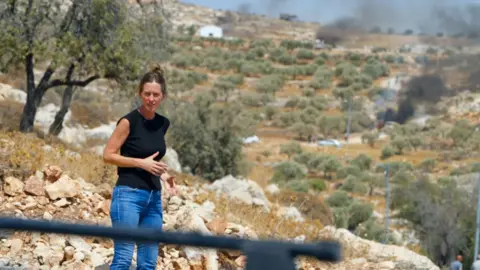
The confrontation quickly spiraled. Thick, acrid smoke soon began to billow skyward, a grim beacon marking the escalating battle. Vegetation by the roadside was set ablaze, while settlers on a quad bike brazenly chased away a volunteer emergency crew attempting to reach a farmhouse caught in the heart of the field.
This wasn't an isolated incident; it's a tragically familiar routine. Residents of these villages south of Nablus endure weekly attacks and confrontations. The strategy is clear: relentless intimidation and destruction, slowly but surely taking over **Palestinian land**, field by field. Yet, even seasoned observers were struck by the sheer speed and terrifying spread of this particular assault.
In just over an hour, dozens of settlers had fanned out across the hills. We watched in horror as they systematically broke into an isolated building, then methodically torched vehicles and homes. On a distant ridge, shepherds frantically herded their flocks away, the hillside behind them erupting in flames, sending plumes of smoke into the sky from multiple points.
---
Blocked Paths, Broken Hopes: The Cost of the Conflict
Flames Across the Horizon: A Landscape Consumed by Conflict
The confrontation quickly spiraled. Thick, acrid smoke soon began to billow skyward, a grim beacon marking the escalating battle. Vegetation by the roadside was set ablaze, while settlers on a quad bike brazenly chased away a volunteer emergency crew attempting to reach a farmhouse caught in the heart of the field.
This wasn't an isolated incident; it's a tragically familiar routine. Residents of these villages south of Nablus endure weekly attacks and confrontations. The strategy is clear: relentless intimidation and destruction, slowly but surely taking over **Palestinian land**, field by field. Yet, even seasoned observers were struck by the sheer speed and terrifying spread of this particular assault.
In just over an hour, dozens of settlers had fanned out across the hills. We watched in horror as they systematically broke into an isolated building, then methodically torched vehicles and homes. On a distant ridge, shepherds frantically herded their flocks away, the hillside behind them erupting in flames, sending plumes of smoke into the sky from multiple points.
---
Blocked Paths, Broken Hopes: The Cost of the Conflict
 As **Palestinians** from across the area rushed to aid their neighbors, they found their main access road blocked by the Israeli army. The destruction continued unimpeded.
Amidst the growing crowd, we met Rifa Said Hamail. Her frantic gestures gave way to a warm, albeit anxious, smile as she recounted her ordeal. Her husband was trapped in their farmhouse near Brahim's olive farm, surrounded by settlers, yet the army refused to let her pass.
"Every other day the settlers do this to us – they attack us, cut down the olive trees, and burn the farms," she lamented. "This is not a life. No one can stop them. We have nothing to resist them with. They have weapons, we have nothing."
Later, we learned the settlers had indeed torched part of her property, leaving her husband with cuts to his face and leg from being struck by rocks. Reports also surfaced of one Palestinian being beaten by settlers, while the Israeli army stated both sides hurled rocks and Palestinians burned tires, confirming four Israeli civilians received medical treatment.
---
The Deepening Crisis: A Surge in Settler Aggression
As **Palestinians** from across the area rushed to aid their neighbors, they found their main access road blocked by the Israeli army. The destruction continued unimpeded.
Amidst the growing crowd, we met Rifa Said Hamail. Her frantic gestures gave way to a warm, albeit anxious, smile as she recounted her ordeal. Her husband was trapped in their farmhouse near Brahim's olive farm, surrounded by settlers, yet the army refused to let her pass.
"Every other day the settlers do this to us – they attack us, cut down the olive trees, and burn the farms," she lamented. "This is not a life. No one can stop them. We have nothing to resist them with. They have weapons, we have nothing."
Later, we learned the settlers had indeed torched part of her property, leaving her husband with cuts to his face and leg from being struck by rocks. Reports also surfaced of one Palestinian being beaten by settlers, while the Israeli army stated both sides hurled rocks and Palestinians burned tires, confirming four Israeli civilians received medical treatment.
---
The Deepening Crisis: A Surge in Settler Aggression
 The Israeli organization Peace Now, a watchdog monitoring **settlements in the West Bank**, paints a grim picture. Since the beginning of last year, approximately 100 new illegal outposts have sprung up across the **occupied territories**. They also revealed that hundreds of square kilometers of **Palestinian land** have been seized in recent years through the same violent pattern of intimidation – a pattern, they argue, emboldened by government support and a glaring lack of proper law enforcement by Israel.
The **conflict escalation** is undeniable. Peace Now reports that settler aggression has multiplied dramatically since the Hamas attacks on Israel in October 2023 and the subsequent Gaza War. Just last week, Israel's far-right Finance Minister, Bezalel Smotrich, openly declared plans for thousands of new housing units in a large **West Bank** settlement bloc, explicitly stating it would "bury the idea of a **Palestinian state**."
The humanitarian cost is staggering. Between August 5th and 11th alone, the UN Office for Humanitarian Affairs documented at least 27 settler attacks against Palestinians, resulting in casualties, property damage, or both, across two dozen different communities. These attacks led to the displacement of 18 households, a grim testament to the ongoing **humanitarian crisis**.
---
Justice Denied: A Community's Plea
We were unable to speak with the settlers involved in the attack. The local settlers' council issued a statement condemning elements on both sides seeking provocation. However, few Palestinians here hold much faith in Israeli justice or security forces, frequently asserting that they exist to protect only the settlers.
The Israeli organization Peace Now, a watchdog monitoring **settlements in the West Bank**, paints a grim picture. Since the beginning of last year, approximately 100 new illegal outposts have sprung up across the **occupied territories**. They also revealed that hundreds of square kilometers of **Palestinian land** have been seized in recent years through the same violent pattern of intimidation – a pattern, they argue, emboldened by government support and a glaring lack of proper law enforcement by Israel.
The **conflict escalation** is undeniable. Peace Now reports that settler aggression has multiplied dramatically since the Hamas attacks on Israel in October 2023 and the subsequent Gaza War. Just last week, Israel's far-right Finance Minister, Bezalel Smotrich, openly declared plans for thousands of new housing units in a large **West Bank** settlement bloc, explicitly stating it would "bury the idea of a **Palestinian state**."
The humanitarian cost is staggering. Between August 5th and 11th alone, the UN Office for Humanitarian Affairs documented at least 27 settler attacks against Palestinians, resulting in casualties, property damage, or both, across two dozen different communities. These attacks led to the displacement of 18 households, a grim testament to the ongoing **humanitarian crisis**.
---
Justice Denied: A Community's Plea
We were unable to speak with the settlers involved in the attack. The local settlers' council issued a statement condemning elements on both sides seeking provocation. However, few Palestinians here hold much faith in Israeli justice or security forces, frequently asserting that they exist to protect only the settlers.
 Yahya al-Khatib, one of the volunteer emergency crew members attempting to assist during the clashes, confirmed these fears. "We were trying to rescue the young men, when the army came, honking at us and telling us to get away from here," he recounted. "We were volunteers wearing our vests. We're not here to attack or harm settlers. We want to put out fires and treat injured people. But they [the army] stop us and stand in our way."
---
The Ultimate Price: A Son's Sacrifice, A Father's Defiance
The wider context for these local tensions is the increasingly heavy control exerted by Israeli forces across the **West Bank**, leading to widespread demolitions and evacuations of refugee camps in the northern region. From January to June of this year, the UN documented a shocking 149 Palestinians killed by Israeli settlers or soldiers in the **occupied West Bank**, compared to nine Israelis killed by Palestinians.
Hours after the clashes around Brahim's farm, another **Palestinian casualty** was added to this somber tally. Eighteen-year-old Hamdan Abu-Elaya was shot and killed by Israeli troops in al-Mughayyir village, just miles from Brahim's field. His mother recounted he had simply gone to see the fires lit by settlers nearby. "I raised him for 18 years, and he was gone in a minute," she wept.
The Israeli army, when asked, stated "terrorists" had thrown rocks and Molotov cocktails at troops in the village, and soldiers had "responded with fire to remove the threat."
Yahya al-Khatib, one of the volunteer emergency crew members attempting to assist during the clashes, confirmed these fears. "We were trying to rescue the young men, when the army came, honking at us and telling us to get away from here," he recounted. "We were volunteers wearing our vests. We're not here to attack or harm settlers. We want to put out fires and treat injured people. But they [the army] stop us and stand in our way."
---
The Ultimate Price: A Son's Sacrifice, A Father's Defiance
The wider context for these local tensions is the increasingly heavy control exerted by Israeli forces across the **West Bank**, leading to widespread demolitions and evacuations of refugee camps in the northern region. From January to June of this year, the UN documented a shocking 149 Palestinians killed by Israeli settlers or soldiers in the **occupied West Bank**, compared to nine Israelis killed by Palestinians.
Hours after the clashes around Brahim's farm, another **Palestinian casualty** was added to this somber tally. Eighteen-year-old Hamdan Abu-Elaya was shot and killed by Israeli troops in al-Mughayyir village, just miles from Brahim's field. His mother recounted he had simply gone to see the fires lit by settlers nearby. "I raised him for 18 years, and he was gone in a minute," she wept.
The Israeli army, when asked, stated "terrorists" had thrown rocks and Molotov cocktails at troops in the village, and soldiers had "responded with fire to remove the threat."
 Hundreds gathered at Hamdan's home for his funeral the next day, his body brought in for his mother's final goodbye. His father, Ameen Abu Elaya, raged to friends and family, refusing to show the Israelis his tears. "They thought if they killed our son, we would leave," he declared. "I will not shout and scream and say 'why has he gone?' I'm not sad that he passed. I encourage young men to do anything they can against the criminal occupier."
At the local mosque, Hamdan's body received a hero's welcome. Vast **Palestinian flags** hung alongside those of Fatah and Hamas from roofs and windows, crowds lining the path of the bier. In the unyielding language of this deeply entrenched **Middle East conflict**, each birth and each burial only serves to strengthen the unbreakable ties to the land, ensuring the struggle for identity and survival continues.
*(Additional reporting by Morgan Gisholt Minard)*
Hundreds gathered at Hamdan's home for his funeral the next day, his body brought in for his mother's final goodbye. His father, Ameen Abu Elaya, raged to friends and family, refusing to show the Israelis his tears. "They thought if they killed our son, we would leave," he declared. "I will not shout and scream and say 'why has he gone?' I'm not sad that he passed. I encourage young men to do anything they can against the criminal occupier."
At the local mosque, Hamdan's body received a hero's welcome. Vast **Palestinian flags** hung alongside those of Fatah and Hamas from roofs and windows, crowds lining the path of the bier. In the unyielding language of this deeply entrenched **Middle East conflict**, each birth and each burial only serves to strengthen the unbreakable ties to the land, ensuring the struggle for identity and survival continues.
*(Additional reporting by Morgan Gisholt Minard)*
Image 1
Image 2
Image 3
Image 4
Image 5
Image 6


Comments
Post a Comment