EU Leaders in US: Urgent Ukraine Aid to Halt Defeat
**A Geopolitical Earthquake Rocks Washington: Europe Rushes to Avert Ukraine's 'Capitulation'**
Imagine a world where the rules of global diplomacy are rewritten overnight, where months of carefully crafted strategy are tossed aside in an instant. This isn't fiction; it's the stark reality that sent European leaders scrambling across the Atlantic, shattering holiday plans and upending their schedules. "No one was expecting this," one official whispered, capturing the sheer shock reverberating through the halls of power. Their urgent mission? To confront a seismic shift in US policy toward the **Ukraine war** and prevent what they fear could be Kyiv's ultimate undoing.
**The Abrupt U-Turn That Sparked Panic**
 The catalyst? A recent, unsettling encounter between US President Donald Trump and Russian President Vladimir Putin in Alaska. In its wake, a dramatic, unilateral pivot in **Trump policy** emerged, sending tremors through international relations. Gone were the preconditions for **peace talks**, specifically the insistence on a **ceasefire** as a prerequisite. Worse, diplomats reported, Trump signaled no intention of imposing further **economic sanctions on Russia**. For European capitals, this wasn't just a policy adjustment; it was an abandonment of shared Western principles, moving the US position alarmingly closer to Russia's demands.
**Why the Sudden Scramble? Europe's Existential Fear**
French President Emmanuel Macron, pictured earlier with Ukrainian President Zelensky, put it bluntly: "There is only one state proposing a peace that would be a capitulation: Russia." This "C word" became the rallying cry for a frantic diplomatic offensive. While ostensibly heading to Washington to bolster President Zelensky, the true aim of these high-stakes meetings was far graver: to prevent Trump from inadvertently, or perhaps intentionally, undermining **long-term European security** and creating a precedent for future Russian aggression.
The catalyst? A recent, unsettling encounter between US President Donald Trump and Russian President Vladimir Putin in Alaska. In its wake, a dramatic, unilateral pivot in **Trump policy** emerged, sending tremors through international relations. Gone were the preconditions for **peace talks**, specifically the insistence on a **ceasefire** as a prerequisite. Worse, diplomats reported, Trump signaled no intention of imposing further **economic sanctions on Russia**. For European capitals, this wasn't just a policy adjustment; it was an abandonment of shared Western principles, moving the US position alarmingly closer to Russia's demands.
**Why the Sudden Scramble? Europe's Existential Fear**
French President Emmanuel Macron, pictured earlier with Ukrainian President Zelensky, put it bluntly: "There is only one state proposing a peace that would be a capitulation: Russia." This "C word" became the rallying cry for a frantic diplomatic offensive. While ostensibly heading to Washington to bolster President Zelensky, the true aim of these high-stakes meetings was far graver: to prevent Trump from inadvertently, or perhaps intentionally, undermining **long-term European security** and creating a precedent for future Russian aggression.
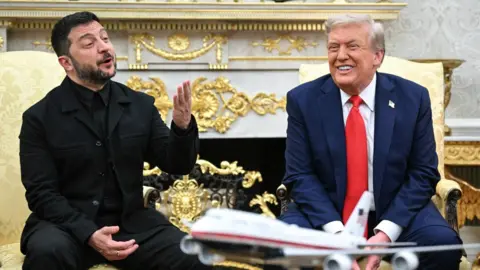 From watersports on the Riviera for Macron to a Greek getaway for Italian Prime Minister Giorgia Meloni, holidays were unceremoniously cut short. Such was the magnitude of Trump's change in diplomatic strategy – and the potential **threat to Europe** – that these **European leaders** dropped everything. Meloni reportedly initiated the desperate dash, quickly followed by Macron, igniting a chain reaction that compelled other EU and NATO officials to join the fray.
**Cloak-and-Dagger Calls: Weekends of Geopolitical Chess**
The weekend before their arrival saw a flurry of secret phone calls and no fewer than five separate group chats among the leaders. This wasn't just about avoiding a "bust-up" reminiscent of a prior Oval Office meeting; it was about preventing a full-blown confrontation – or, worse, capitulation – for Ukraine and, by extension, for the entire continent.
From watersports on the Riviera for Macron to a Greek getaway for Italian Prime Minister Giorgia Meloni, holidays were unceremoniously cut short. Such was the magnitude of Trump's change in diplomatic strategy – and the potential **threat to Europe** – that these **European leaders** dropped everything. Meloni reportedly initiated the desperate dash, quickly followed by Macron, igniting a chain reaction that compelled other EU and NATO officials to join the fray.
**Cloak-and-Dagger Calls: Weekends of Geopolitical Chess**
The weekend before their arrival saw a flurry of secret phone calls and no fewer than five separate group chats among the leaders. This wasn't just about avoiding a "bust-up" reminiscent of a prior Oval Office meeting; it was about preventing a full-blown confrontation – or, worse, capitulation – for Ukraine and, by extension, for the entire continent.
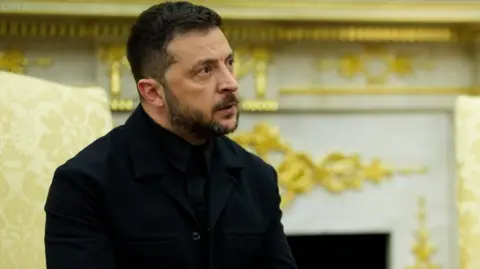 Officials are still grappling with the "huge impact" of these two decisions by Trump, which they believe have been severely "under-priced." "Things have moved very significantly and quite quickly to a timetable that no one was expecting," one European official revealed, hinting at the breakneck pace of this **geopolitical crisis**. "The US sees this as a moment to strike while the iron is hot. Our question is what are we trying to achieve here?"
**Beyond Ukraine: Securing a Continent**
"This is fundamentally about the security of our continent," asserted a British diplomat, echoing the sentiment of their peers. The shift isn't merely about Ukraine's borders; it's about the very architecture of **European security** and the principles underpinning international law. The European position has long been clear: any genuine path to peace requires Russia to demonstrate a desire for dialogue, starting with a ceasefire. But that goal now seems distant, replaced by a more immediate and terrifying question: "how we can get out of today without a blow-up. This is a moment of extreme jeopardy."
Officials are still grappling with the "huge impact" of these two decisions by Trump, which they believe have been severely "under-priced." "Things have moved very significantly and quite quickly to a timetable that no one was expecting," one European official revealed, hinting at the breakneck pace of this **geopolitical crisis**. "The US sees this as a moment to strike while the iron is hot. Our question is what are we trying to achieve here?"
**Beyond Ukraine: Securing a Continent**
"This is fundamentally about the security of our continent," asserted a British diplomat, echoing the sentiment of their peers. The shift isn't merely about Ukraine's borders; it's about the very architecture of **European security** and the principles underpinning international law. The European position has long been clear: any genuine path to peace requires Russia to demonstrate a desire for dialogue, starting with a ceasefire. But that goal now seems distant, replaced by a more immediate and terrifying question: "how we can get out of today without a blow-up. This is a moment of extreme jeopardy."
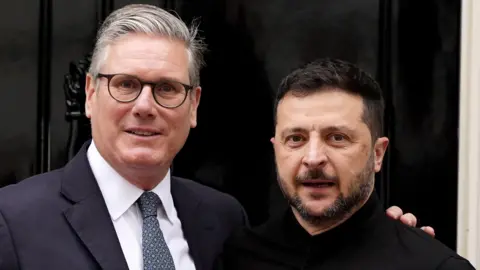 The visiting delegation intends to challenge two critical notions currently circulating in the White House:
1. **The myth of easy peace:** The idea that peace can be achieved simply by Ukraine ceding territory like the Donbas to Russia.
2. **The illusion of isolation:** The belief that this conflict is solely about Ukraine and not a direct threat to the wider stability of Europe.
**Empty Words vs. Real Protection: The Battle Over Security Guarantees**
A key battleground in these tense negotiations centers on the nature of **security guarantees**. US negotiators have hinted at undefined "NATO-style assurances," but the specifics remain hazy. "Nobody is clear what Trump means about a security guarantee," an official noted, expressing deep concern. "He believes that him simply saying to Putin 'don't attack' is enough. That's not good enough for Ukraine or us."
The visiting delegation intends to challenge two critical notions currently circulating in the White House:
1. **The myth of easy peace:** The idea that peace can be achieved simply by Ukraine ceding territory like the Donbas to Russia.
2. **The illusion of isolation:** The belief that this conflict is solely about Ukraine and not a direct threat to the wider stability of Europe.
**Empty Words vs. Real Protection: The Battle Over Security Guarantees**
A key battleground in these tense negotiations centers on the nature of **security guarantees**. US negotiators have hinted at undefined "NATO-style assurances," but the specifics remain hazy. "Nobody is clear what Trump means about a security guarantee," an official noted, expressing deep concern. "He believes that him simply saying to Putin 'don't attack' is enough. That's not good enough for Ukraine or us."
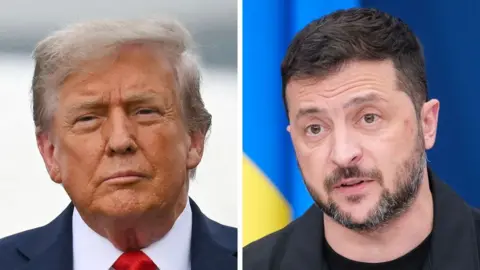 For the Europeans, genuine security for Ukraine—and thus for Europe—demands more than verbal promises. It means a robust, long-term commitment to a strong Ukrainian army, supported by substantial allied **military and financial support**. This includes:
* American weapons, potentially purchased by Europeans and gifted to Ukraine.
* Continued Ukrainian access to vital US intelligence.
Such a framework would directly contradict Russian demands for the "demilitarisation of Ukraine," ensuring Kyiv retains its defensive capabilities. This strategy underscores the crucial link between territorial integrity and substantive security commitments.
**The Diplomatic Tightrope: A Risky Dance with Trump**
For the Europeans, genuine security for Ukraine—and thus for Europe—demands more than verbal promises. It means a robust, long-term commitment to a strong Ukrainian army, supported by substantial allied **military and financial support**. This includes:
* American weapons, potentially purchased by Europeans and gifted to Ukraine.
* Continued Ukrainian access to vital US intelligence.
Such a framework would directly contradict Russian demands for the "demilitarisation of Ukraine," ensuring Kyiv retains its defensive capabilities. This strategy underscores the crucial link between territorial integrity and substantive security commitments.
**The Diplomatic Tightrope: A Risky Dance with Trump**
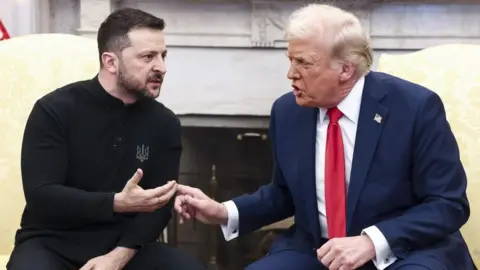 This hastily assembled European delegation, described as "quite unwieldy" by one official, faces a precarious balancing act. They risk pushing Trump too hard, provoking his perception of being "bullied," and seeing the meetings derail completely. Differing views among the Europeans on the extent of their commitment to Ukraine's future security further complicate matters. What role, for instance, would a future European-based "reassurance" force play in a post-conflict Ukraine? The answer remains unclear.
For now, the European aim is to slow down the frenetic pace of diplomacy and cool the "fevered talk" of land-swap deals that should rightfully be part of the endgame, not the starting gun, of a negotiation. To them, putting the cart before the horse risks disaster.
Instead, the **European leaders** will advocate for a more structured path:
* Progress towards a possible trilateral summit involving Trump, Zelensky, and Putin.
* The carving out of broad principles to guide any future peace agreement.
* Establishing a framework for "talks about talks," defining the location and structure of negotiations.
* And, crucially, affirming that such negotiations can only genuinely commence once a ceasefire has been agreed.
As President Macron stated, European leaders will directly ask Trump "to what extent" he would back meaningful **security guarantees** for Ukraine. The outcome of these urgent talks will not only shape the future of Ukraine but could redefine the stability of an entire continent. The world watches, holding its breath, as these leaders embark on a mission to safeguard not just a nation, but the very principles of international order. The answer could reshape the world order as we know it.
This hastily assembled European delegation, described as "quite unwieldy" by one official, faces a precarious balancing act. They risk pushing Trump too hard, provoking his perception of being "bullied," and seeing the meetings derail completely. Differing views among the Europeans on the extent of their commitment to Ukraine's future security further complicate matters. What role, for instance, would a future European-based "reassurance" force play in a post-conflict Ukraine? The answer remains unclear.
For now, the European aim is to slow down the frenetic pace of diplomacy and cool the "fevered talk" of land-swap deals that should rightfully be part of the endgame, not the starting gun, of a negotiation. To them, putting the cart before the horse risks disaster.
Instead, the **European leaders** will advocate for a more structured path:
* Progress towards a possible trilateral summit involving Trump, Zelensky, and Putin.
* The carving out of broad principles to guide any future peace agreement.
* Establishing a framework for "talks about talks," defining the location and structure of negotiations.
* And, crucially, affirming that such negotiations can only genuinely commence once a ceasefire has been agreed.
As President Macron stated, European leaders will directly ask Trump "to what extent" he would back meaningful **security guarantees** for Ukraine. The outcome of these urgent talks will not only shape the future of Ukraine but could redefine the stability of an entire continent. The world watches, holding its breath, as these leaders embark on a mission to safeguard not just a nation, but the very principles of international order. The answer could reshape the world order as we know it.
Image 1
Image 2
Image 3
Image 4
Image 5
Image 6


Comments
Post a Comment