Putin's Alaska 'Welcome': Ukraine's Cold Fury
The Red Carpet Welcome That Crushed Ukrainian Hopes: When Global Diplomacy Ignores a Bloody War
Imagine a world where a leader accused of orchestrating a brutal war of aggression, responsible for countless deaths and unspeakable suffering, is welcomed on the global stage with pomp, circumstance, and a beaming smile. This isn't a dystopian novel; it was the unsettling reality of the recent **Trump-Putin summit** in Alaska, a diplomatic spectacle that left Ukrainians reeling and raised profound questions about **international diplomacy** and the pursuit of peace.
While the world braced for a potential geopolitical earthquake, the summit, for all its dazzling optics, ultimately fizzled out. Yet, for Ukraine, the "failure" brought little comfort. Instead, the very imagery of the meeting — a velvet welcome for **Vladimir Putin** — struck a discordant, devastating chord.
A Frightening Friday Night: What Ukraine Feared
 Ukrainians had gone to bed on Friday night clutching a chilling dread: the possibility that **Donald Trump** might, under Putin's sway, offer significant concessions on the ongoing **Ukraine war**. The thought of their sovereignty and future being bartered away by two powerful men was a terrifying prospect, painting a stark picture of the **geopolitical tensions** at play.
They awoke on Saturday morning to a surprising relief. The highly anticipated **Trump-Putin summit** in Alaska had evaporated into thin air, yielding no strategic or political breakthroughs. For once, a failed summit was a cause for exhaling, a brief reprieve from the brink. But the morning brought a different, equally unsettling truth.
The Summit That Fizzled, But Stirred Fury
In the absence of concrete agreements, attention in **Kyiv** and across Ukraine turned to the summit's "optics"—its elaborate presentation. And what they saw was a jarring sight: **Vladimir Putin**, the man behind the devastating **Russian aggression** in Ukraine, receiving the kind of lavish welcome typically reserved for a revered head of state.
Ukrainians had gone to bed on Friday night clutching a chilling dread: the possibility that **Donald Trump** might, under Putin's sway, offer significant concessions on the ongoing **Ukraine war**. The thought of their sovereignty and future being bartered away by two powerful men was a terrifying prospect, painting a stark picture of the **geopolitical tensions** at play.
They awoke on Saturday morning to a surprising relief. The highly anticipated **Trump-Putin summit** in Alaska had evaporated into thin air, yielding no strategic or political breakthroughs. For once, a failed summit was a cause for exhaling, a brief reprieve from the brink. But the morning brought a different, equally unsettling truth.
The Summit That Fizzled, But Stirred Fury
In the absence of concrete agreements, attention in **Kyiv** and across Ukraine turned to the summit's "optics"—its elaborate presentation. And what they saw was a jarring sight: **Vladimir Putin**, the man behind the devastating **Russian aggression** in Ukraine, receiving the kind of lavish welcome typically reserved for a revered head of state.
 American soldiers knelt, literally unrolling a red carpet for him. Trump applauded his approach, offering a friendly handshake. The two leaders rode together, alone, in Trump's presidential limousine, Putin seen laughing as the car pulled away. It was a scene carefully choreographed for a global audience, but what message did it truly send?
Red Carpets and Diplomatic Rehabilitations
For the Russian president, who has been largely shunned by the international community since his full-scale invasion of Ukraine, this grand greeting marked the beginning of a remarkable, if unsettling, return to the global diplomatic stage. It set a tone of legitimacy that persisted throughout the day, a stark contrast to his status as an internationally wanted **war criminal**.
"Red carpets and this level of ceremony are normal at international events," acknowledged Maria Drachova, a 40-year-old lawyer in Kyiv, who watched the footage unfold over her breakfast. "But in this case – for an aggressor responsible for the deaths of millions – it should not have happened." She concluded with a bitter observation: "The rational world is behaving irrationally by giving him this welcome."
American soldiers knelt, literally unrolling a red carpet for him. Trump applauded his approach, offering a friendly handshake. The two leaders rode together, alone, in Trump's presidential limousine, Putin seen laughing as the car pulled away. It was a scene carefully choreographed for a global audience, but what message did it truly send?
Red Carpets and Diplomatic Rehabilitations
For the Russian president, who has been largely shunned by the international community since his full-scale invasion of Ukraine, this grand greeting marked the beginning of a remarkable, if unsettling, return to the global diplomatic stage. It set a tone of legitimacy that persisted throughout the day, a stark contrast to his status as an internationally wanted **war criminal**.
"Red carpets and this level of ceremony are normal at international events," acknowledged Maria Drachova, a 40-year-old lawyer in Kyiv, who watched the footage unfold over her breakfast. "But in this case – for an aggressor responsible for the deaths of millions – it should not have happened." She concluded with a bitter observation: "The rational world is behaving irrationally by giving him this welcome."
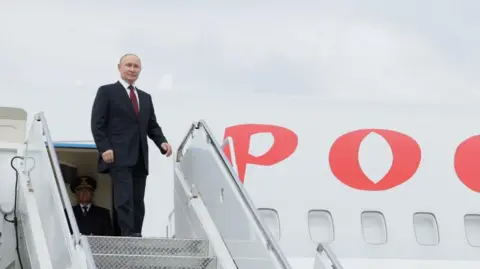
 Indeed, Putin's plane was escorted by four American fighter jets into the Alaskan airbase. As he strolled down the red carpet, jovially conversing with Trump, an American B-2 bomber, flanked by four more jets, flew impressively overhead. To many Ukrainians, who had stayed up late to watch, this was nothing less than the "legitimisation of a **war criminal** at the highest level," stated Oleksandr Kovalenko, a Ukrainian writer and political analyst. "There was no need for this pomp at all," he insisted. "This is a meeting that should have been conducted in a much more restrained way – minimalistic, without this level of respect."
The Smirk Heard 'Round Ukraine
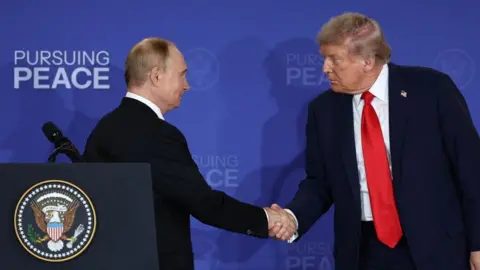
After the grand greetings, Trump and Putin sat before a gaggle of reporters at Elmendorf Air Force Base, beneath a banner proclaiming "Pursuing Peace." A question was shouted at Putin, stark and direct: "Will you stop killing civilians?"
The Russian leader's response was chilling. He appeared to smirk, gesturing to his ear to suggest he hadn't heard. Amidst the smiles, laughter, and general good will on show, this gesture struck a profoundly sour note in Ukraine, a nation where hundreds of thousands have been killed and wounded in Russia's brutal **war of aggression**.
Indeed, Putin's plane was escorted by four American fighter jets into the Alaskan airbase. As he strolled down the red carpet, jovially conversing with Trump, an American B-2 bomber, flanked by four more jets, flew impressively overhead. To many Ukrainians, who had stayed up late to watch, this was nothing less than the "legitimisation of a **war criminal** at the highest level," stated Oleksandr Kovalenko, a Ukrainian writer and political analyst. "There was no need for this pomp at all," he insisted. "This is a meeting that should have been conducted in a much more restrained way – minimalistic, without this level of respect."
The Smirk Heard 'Round Ukraine
After the grand greetings, Trump and Putin sat before a gaggle of reporters at Elmendorf Air Force Base, beneath a banner proclaiming "Pursuing Peace." A question was shouted at Putin, stark and direct: "Will you stop killing civilians?"
The Russian leader's response was chilling. He appeared to smirk, gesturing to his ear to suggest he hadn't heard. Amidst the smiles, laughter, and general good will on show, this gesture struck a profoundly sour note in Ukraine, a nation where hundreds of thousands have been killed and wounded in Russia's brutal **war of aggression**.
 "When I saw what happened, I felt crushed," shared Serhii Orlyk, 50, from the eastern province of Donetsk, an area largely seized by Russian forces and scarred by some of the war's most intense fighting. "I lost my home twice... I lost relatives." While understanding the need for diplomatic protocol, Orlyk found the "unpleasant spectacle – especially his smirks" deeply painful.
Beyond the Handshakes: A Strategic Victory for Putin?
The deference to Putin continued even after the negotiations. In a joint statement to the press, Trump yielded the floor to the Russian leader first. Putin spoke for a full eight minutes, carefully sidestepping any mention of how the war actually began – with Russia's striking and unprovoked aggression. He appeared energetic, satisfied. Trump, in stark contrast, seemed uncharacteristically deflated, speaking for barely two minutes. He had no grand deal to boast of, the usual currency of his diplomatic endeavors.
Instead, he seemed to have handed the initiative to Putin, according to Kier Giles, a senior fellow in the Russia and Eurasia program at Chatham House. "It was a massive victory for Putin even before he got off the plane, to be rehabilitated in this manner," Giles asserted. "Trump has facilitated him arriving to be greeted as a head of state, when he ought to be finding it difficult to travel because he is an internationally wanted **war criminal**."
"When I saw what happened, I felt crushed," shared Serhii Orlyk, 50, from the eastern province of Donetsk, an area largely seized by Russian forces and scarred by some of the war's most intense fighting. "I lost my home twice... I lost relatives." While understanding the need for diplomatic protocol, Orlyk found the "unpleasant spectacle – especially his smirks" deeply painful.
Beyond the Handshakes: A Strategic Victory for Putin?
The deference to Putin continued even after the negotiations. In a joint statement to the press, Trump yielded the floor to the Russian leader first. Putin spoke for a full eight minutes, carefully sidestepping any mention of how the war actually began – with Russia's striking and unprovoked aggression. He appeared energetic, satisfied. Trump, in stark contrast, seemed uncharacteristically deflated, speaking for barely two minutes. He had no grand deal to boast of, the usual currency of his diplomatic endeavors.
Instead, he seemed to have handed the initiative to Putin, according to Kier Giles, a senior fellow in the Russia and Eurasia program at Chatham House. "It was a massive victory for Putin even before he got off the plane, to be rehabilitated in this manner," Giles asserted. "Trump has facilitated him arriving to be greeted as a head of state, when he ought to be finding it difficult to travel because he is an internationally wanted **war criminal**."
 The Road Ahead: Zelensky's Challenge and Europe's Resolve
Giles also suggested Trump's approach would likely not inspire **European leaders** to follow suit. "If anything, it will reinforce how important it is not to endorse Putin's demands on Ukraine, and not to subject themselves to the same kinds of spectacle that is earning Trump scorn."
In a statement on Saturday, President Zelensky underscored the critical importance of European leaders being present at every stage of **peace negotiations**. They are often seen as a crucial bulwark against the possibility of Trump being unduly influenced by Putin.
Zelensky is now headed back to Washington, the scene of his "disastrous" Oval Office clash with Trump earlier this year. He will be hoping for a better outcome this time, a clearer path to peace that doesn't involve surrendering to Russia's aggressive demands. Oleksandr Kovalenko, the political analyst, believes the US has a "wide range of tools" to assist Ukraine in this mission, but stresses that "pomp and ceremony for President Putin should not be among them."
The Road Ahead: Zelensky's Challenge and Europe's Resolve
Giles also suggested Trump's approach would likely not inspire **European leaders** to follow suit. "If anything, it will reinforce how important it is not to endorse Putin's demands on Ukraine, and not to subject themselves to the same kinds of spectacle that is earning Trump scorn."
In a statement on Saturday, President Zelensky underscored the critical importance of European leaders being present at every stage of **peace negotiations**. They are often seen as a crucial bulwark against the possibility of Trump being unduly influenced by Putin.
Zelensky is now headed back to Washington, the scene of his "disastrous" Oval Office clash with Trump earlier this year. He will be hoping for a better outcome this time, a clearer path to peace that doesn't involve surrendering to Russia's aggressive demands. Oleksandr Kovalenko, the political analyst, believes the US has a "wide range of tools" to assist Ukraine in this mission, but stresses that "pomp and ceremony for President Putin should not be among them."
 Was this elaborate welcome merely a strategic ploy to "deceive and flatter Putin," perhaps to nudge him towards the White House's agenda? Or was it, as Kovalenko speculates, simply "Trump's whim, without any strategy at all?"
The implications of this **diplomatic spectacle** are far-reaching, shaping not just the narrative around the **Ukraine war**, but the very future of international relations. What unpredictable twist awaits next in this high-stakes geopolitical drama? And what will it ultimately mean for the enduring quest for true peace?
Was this elaborate welcome merely a strategic ploy to "deceive and flatter Putin," perhaps to nudge him towards the White House's agenda? Or was it, as Kovalenko speculates, simply "Trump's whim, without any strategy at all?"
The implications of this **diplomatic spectacle** are far-reaching, shaping not just the narrative around the **Ukraine war**, but the very future of international relations. What unpredictable twist awaits next in this high-stakes geopolitical drama? And what will it ultimately mean for the enduring quest for true peace?
Image 1
Image 2
Image 3
Image 4
Image 5
Image 6


Comments
Post a Comment