White House Talks Overshadow US-Russia Alaska Summit
Beyond the Summit: Why Washington Holds Ukraine's True Future
Forget the dramatic headlines of that highly anticipated Trump-Putin summit. While the world held its breath, expecting grand announcements from Alaska, the real drama for **Ukraine's future** – and indeed, for the bedrock of **European security** – was quietly unfolding in Washington D.C. Why might these less-hyped White House discussions be far more vital than a flashy **US-Russia reunion**?
The Eerie Silence from Alaska: A Chilling Prospect
 Last Friday's **US-Russia summit** felt like a cinematic letdown. No grand ceasefire. No new sanctions. Just an eerie quiet that left many wondering: were Ukraine and its allies about to be sidelined, their fate decided by a closed-door deal between the world's most formidable nuclear powers? The prospect of **Ukraine peace talks** happening *without* Ukraine was a chilling thought, certainly.
A United Front: Zelensky's Bold Stand in Washington
But Ukraine, with its steadfast partners, isn't about to let that happen. Picture this: President Zelensky, no stranger to the Oval Office, arrives in Washington D.C. not merely for a courtesy call, but flanked by a powerful coalition. Sir Keir Starmer, President Macron, and Chancellor Merz stand shoulder-to-shoulder, forming a formidable, united front. Their mission goes beyond preventing another ambush like February 28th. They are there to ensure President Trump hears two resounding truths.
Last Friday's **US-Russia summit** felt like a cinematic letdown. No grand ceasefire. No new sanctions. Just an eerie quiet that left many wondering: were Ukraine and its allies about to be sidelined, their fate decided by a closed-door deal between the world's most formidable nuclear powers? The prospect of **Ukraine peace talks** happening *without* Ukraine was a chilling thought, certainly.
A United Front: Zelensky's Bold Stand in Washington
But Ukraine, with its steadfast partners, isn't about to let that happen. Picture this: President Zelensky, no stranger to the Oval Office, arrives in Washington D.C. not merely for a courtesy call, but flanked by a powerful coalition. Sir Keir Starmer, President Macron, and Chancellor Merz stand shoulder-to-shoulder, forming a formidable, united front. Their mission goes beyond preventing another ambush like February 28th. They are there to ensure President Trump hears two resounding truths.
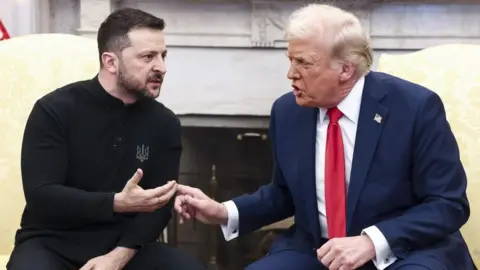 The Double Imperative: Ukraine's Voice and Ironclad Guarantees
First, there can be **no peace deal for Ukraine without Ukraine's direct, unequivocal involvement.** This isn't a spectator sport for Kyiv; it's their very existence on the line. Second, any resolution must be cemented by 'cast-iron' **security guarantees Ukraine** can count on – a robust shield potent enough to deter future **Russian aggression**. This isn't just about diplomatic maneuvering; it's about safeguarding a sovereign nation's hard-won independence and ensuring stability for the entire continent.
Navigating the Trump Tangle: Diplomacy's High Stakes
The Double Imperative: Ukraine's Voice and Ironclad Guarantees
First, there can be **no peace deal for Ukraine without Ukraine's direct, unequivocal involvement.** This isn't a spectator sport for Kyiv; it's their very existence on the line. Second, any resolution must be cemented by 'cast-iron' **security guarantees Ukraine** can count on – a robust shield potent enough to deter future **Russian aggression**. This isn't just about diplomatic maneuvering; it's about safeguarding a sovereign nation's hard-won independence and ensuring stability for the entire continent.
Navigating the Trump Tangle: Diplomacy's High Stakes
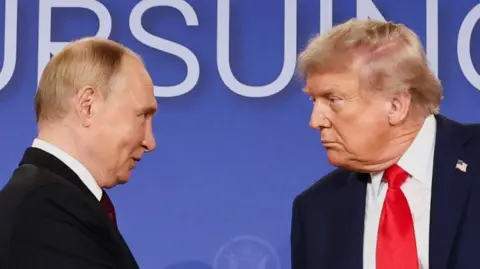 The stakes are undeniably high, especially with President Trump's known personal rapport with Vladimir Putin. Europe's leaders are acutely aware of this, desperate to ensure that personal chemistry doesn't override geopolitical reality. This is precisely where the legendary diplomatic acumen of Sir Keir Starmer will face its ultimate test. Trump likes Starmer, and crucially, he listens to him – a dynamic set to be amplified during Trump's upcoming state visit to the UK.
Also in attendance is Mark Rutte, **NATO's Secretary-General**, often dubbed 'the Trump Whisperer' for his ability to bridge divides with the US President. Yet, not all diplomatic paths are smooth. President Macron, for instance, faces White House criticism over his intention to unconditionally recognize a Palestinian state. Such nuanced relationships are the chessboard upon which **international relations** and Ukraine's future are being played out.
The Impossible Choice: Land for Peace?
The stakes are undeniably high, especially with President Trump's known personal rapport with Vladimir Putin. Europe's leaders are acutely aware of this, desperate to ensure that personal chemistry doesn't override geopolitical reality. This is precisely where the legendary diplomatic acumen of Sir Keir Starmer will face its ultimate test. Trump likes Starmer, and crucially, he listens to him – a dynamic set to be amplified during Trump's upcoming state visit to the UK.
Also in attendance is Mark Rutte, **NATO's Secretary-General**, often dubbed 'the Trump Whisperer' for his ability to bridge divides with the US President. Yet, not all diplomatic paths are smooth. President Macron, for instance, faces White House criticism over his intention to unconditionally recognize a Palestinian state. Such nuanced relationships are the chessboard upon which **international relations** and Ukraine's future are being played out.
The Impossible Choice: Land for Peace?
 For a sustainable **Ukraine peace deal** to even begin to take root, something fundamentally has to give. European leaders have repeatedly declared that **international borders** cannot be redrawn by force. President Zelensky himself has echoed this sentiment, resolute that Ukraine will not surrender its land, a position enshrined within its very constitution.
But then there's Putin.
Vladimir Putin, whose forces already control a staggering 85% of the Donbas, has made his intentions crystal clear: he has no plans to ever relinquish Crimea. It's a brutal deadlock: Ukrainian sovereignty versus Russian ambition. **Is there a third path to victory?**
For a sustainable **Ukraine peace deal** to even begin to take root, something fundamentally has to give. European leaders have repeatedly declared that **international borders** cannot be redrawn by force. President Zelensky himself has echoed this sentiment, resolute that Ukraine will not surrender its land, a position enshrined within its very constitution.
But then there's Putin.
Vladimir Putin, whose forces already control a staggering 85% of the Donbas, has made his intentions crystal clear: he has no plans to ever relinquish Crimea. It's a brutal deadlock: Ukrainian sovereignty versus Russian ambition. **Is there a third path to victory?**
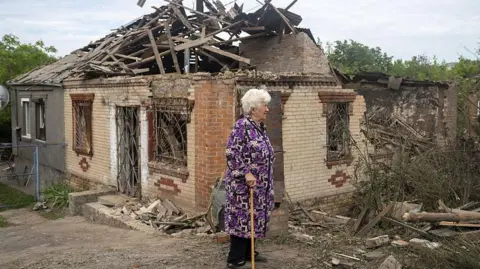 Redefining Victory: A Shield, Not Just a Sword
As former Estonian Prime Minister and Europe's top diplomat, Kaja Kallas, once shrewdly observed, "Victory for Ukraine doesn't *exclusively* have to mean reconquering every inch of occupied territory." Imagine a scenario where Ukraine secures Article 5-type security guarantees – a powerful collective defense shield against future Russian aggression, safeguarding its independence as a free, sovereign state. For many, that would be a profound form of victory, a true testament to **geopolitical strategy** and strategic diplomacy.
The Trade-Off: Lingering Doubts and Dangerous Questions
Redefining Victory: A Shield, Not Just a Sword
As former Estonian Prime Minister and Europe's top diplomat, Kaja Kallas, once shrewdly observed, "Victory for Ukraine doesn't *exclusively* have to mean reconquering every inch of occupied territory." Imagine a scenario where Ukraine secures Article 5-type security guarantees – a powerful collective defense shield against future Russian aggression, safeguarding its independence as a free, sovereign state. For many, that would be a profound form of victory, a true testament to **geopolitical strategy** and strategic diplomacy.
The Trade-Off: Lingering Doubts and Dangerous Questions
 Whispers suggest the US and Russia have been exploring a proposal: a difficult trade-off of some Ukrainian land in exchange for these critical security assurances, ensuring no more territory is lost. But the question marks looming over this concept are immense. Could Ukraine, after thousands of lives lost defending its soil, truly accept a peace that costs it land? If forced to cede the remaining 30% of Donetsk Oblast, currently outside Russian control, would that leave the vital path westwards to Kyiv dangerously exposed and vulnerable?
The Evolving Coalition and the Enduring Threat
And what of Starmer's much-vaunted 'Coalition of the Willing'? Earlier discussions of tens of thousands of 'boots on the ground' have gracefully evolved. The focus now sharpens on 'safeguarding skies and seas' while empowering Ukraine to rebuild its formidable army.
But even if the guns fall silent on the battlefield, we're not out of the woods yet. Every military expert I've consulted warns of a chilling reality: the moment fighting ceases, Putin will inevitably reconstitute his forces, build more weapons, and position himself, perhaps in as little as three to four years, to snatch even more land. The true battle for lasting peace and **European security**, it seems, may only just be beginning. When that inevitable day arrives, who among us will be brave enough – a Typhoon or F35 pilot, perhaps – to fire that first missile against an advancing Russian column? The clock is ticking, and the decisions made in Washington today will echo for generations.
Whispers suggest the US and Russia have been exploring a proposal: a difficult trade-off of some Ukrainian land in exchange for these critical security assurances, ensuring no more territory is lost. But the question marks looming over this concept are immense. Could Ukraine, after thousands of lives lost defending its soil, truly accept a peace that costs it land? If forced to cede the remaining 30% of Donetsk Oblast, currently outside Russian control, would that leave the vital path westwards to Kyiv dangerously exposed and vulnerable?
The Evolving Coalition and the Enduring Threat
And what of Starmer's much-vaunted 'Coalition of the Willing'? Earlier discussions of tens of thousands of 'boots on the ground' have gracefully evolved. The focus now sharpens on 'safeguarding skies and seas' while empowering Ukraine to rebuild its formidable army.
But even if the guns fall silent on the battlefield, we're not out of the woods yet. Every military expert I've consulted warns of a chilling reality: the moment fighting ceases, Putin will inevitably reconstitute his forces, build more weapons, and position himself, perhaps in as little as three to four years, to snatch even more land. The true battle for lasting peace and **European security**, it seems, may only just be beginning. When that inevitable day arrives, who among us will be brave enough – a Typhoon or F35 pilot, perhaps – to fire that first missile against an advancing Russian column? The clock is ticking, and the decisions made in Washington today will echo for generations.
Image 1
Image 2
Image 3
Image 4
Image 5
Image 6


Comments
Post a Comment